
Essure Side Effects Were Reported for 14 Years Before Patients Heard a Word
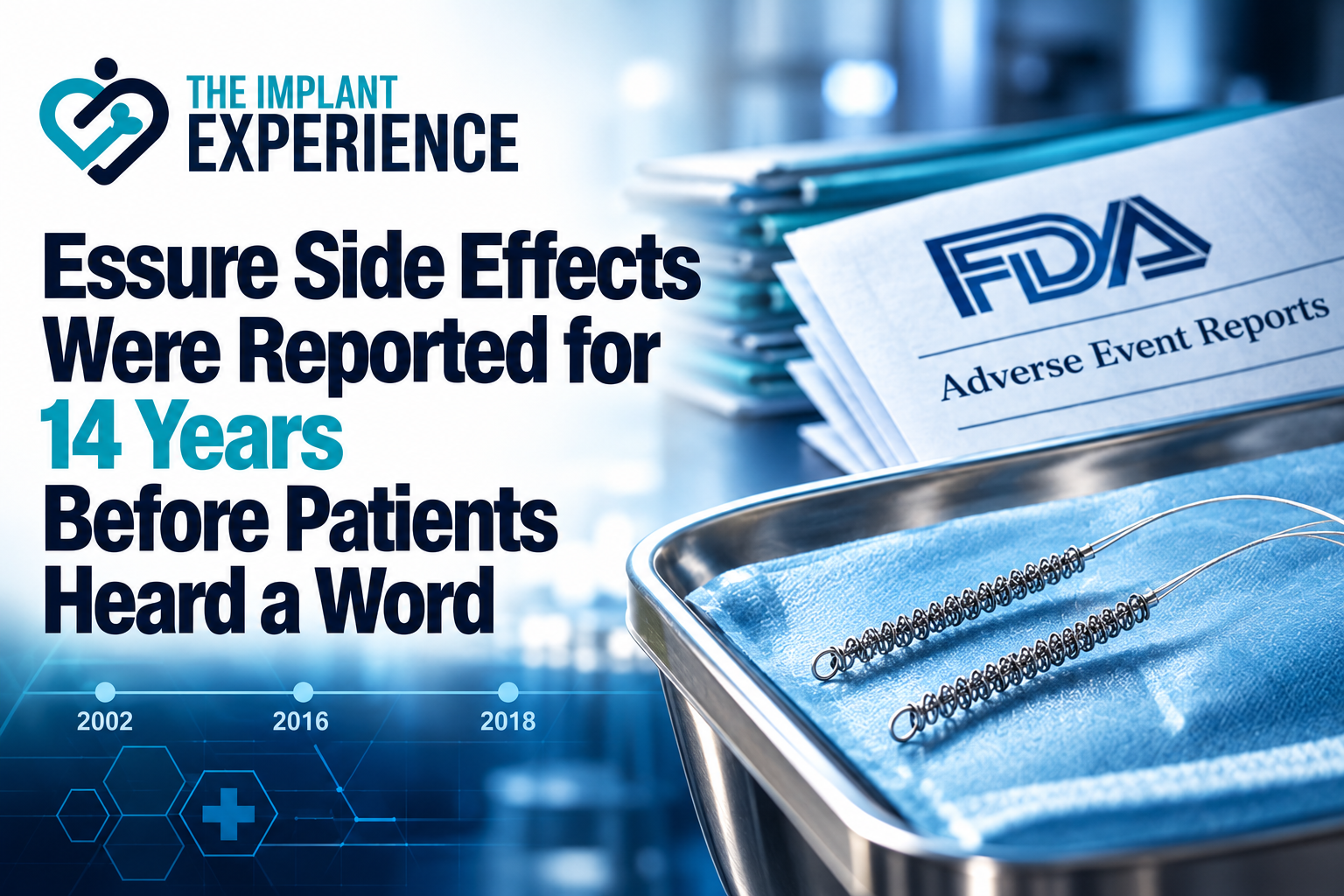
Essure side effects were reported to the FDA for fourteen years before the device received a boxed warning. This is the story of why patients were the last to know, told from the public record, and what you can do so it is never your story.
Based on EP-01 of The Implant Experience, "Rethink the Narrative," with founder John Owens.
One number, and one question nobody can answer
Last year, the FDA received 2,888,003 adverse event reports about medical devices. Every one is a report on file, not a conclusion, and most implants serve patients well.
But here is the question that opens EP-01. If the implant inside your body were recalled tomorrow, who is required to tell you? The manufacturer? The hospital? The FDA?
The answer is no one. No law requires it. A December 2025 audit by the Government Accountability Office (GAO) confirmed that the FDA lacks the legal authority to require that patients be notified of an implant recall.
Two things most of us assume
John Owens spent more than twenty years inside the healthcare industry, as a medical device rep and as the owner of a company that managed medical device documentation in surgical settings. In EP-01 he takes on two assumptions almost all of us carry:
Someone would tell us if the implant inside our body were recalled.
There is nothing we could do about it if something were wrong.
Neither is true. And this is not about blame. In his words: "We don't have bad doctors. That is just the route they were handed." The problem is the information system, never the clinicians inside it.
What the public record says about implant recall
All of it is public, and none of it is John's. Four facts do the work:
913 days. That is the median time for the most serious class of recall, Class I, just to get started. Not resolved. Not communicated to you. Started. (Median across 189 Class I recalls, 2018 to 2022.)
91 percent of device recalls sit in classes that were never structurally routed to the patient at all. (openFDA enforcement database; GAO-26-107619.)
Almost every recall that gets started is the implant manufacturer's own decision to make. (GAO-26-107619, firm-initiated recalls.)
96.6 percent of adverse event reports come from manufacturers. A peer-reviewed study of 7,766,737 records from 1997 to 2018 sorted them by who filed them. The company is the gatekeeper of its own safety signal. (Kavanagh et al., Patient Related Outcome Measures, 2019.)
The FDA's own power to force a recall has been used four times in history. The last was in 1992.
Here is how the route works in practice. You tell your doctor something is wrong. Your doctor reports it to the manufacturer. The manufacturer takes it from there, with no connection back to the patient carrying the device. That is medical device safety by design, and it is why the story below took so long.
The Essure timeline: a permanent birth control implant
Essure was a permanent birth control implant: two small metal coils placed without surgery and marketed as the non-surgical alternative to getting your tubes tied. For many women it worked exactly as promised. That matters, and it is part of the record.
For others, it did not. Adverse event reports describe coils that migrated, perforated organs or broke, along with chronic pain, autoimmune reactions and bleeding. In some cases, Essure removal required a hysterectomy, a surgery to reverse the procedure that was sold as the one you did not need surgery for. Many of those women went to their doctors and were told the device was not the problem.
Now follow the dates:
| Year | What happened |
|---|---|
| 2002 | FDA approves Essure |
| 2016 | FDA adds a boxed warning. Not a recall. A warning. |
| 2018 | Essure leaves the US market at the end of the year |
The FDA's own adverse event database holds 73,678 reports on Essure through 2024. Around 10,000 of them describe perforation of an organ. These are reports, not adjudicated causes. A report is not a verdict.
There was also a question of whether reports were reaching the system at all. In the Essure litigation, plaintiffs' experts sampled more than 5,000 complaints that had come in to the company. About 24 percent should have been reported to regulators. Only 5.5 percent were. (ICIJ coverage of the Essure litigation, 2020.)
On the legal side, Bayer agreed in August 2020 to pay about $1.6 billion to resolve roughly 39,000 claims. That was a settlement, not a verdict, with no admission of wrongdoing. Bayer has said that pulling Essure from the US market was a business decision, not a safety or efficacy one. You are capable of weighing that yourself.
The part that changed everything
So who forced the change? Not the FDA. Not the implant company. Not a journalist.
It began with a woman who had been harmed by the device and started a Facebook group to warn her friends. The group grew, and the women in it did more than commiserate. They got organized. They taught each other how to file adverse event reports with the FDA, the reports the system had been missing, and they filed them themselves. They testified, went to Congress and went to the press. Their story sits at the center of the 2018 documentary The Bleeding Edge (Jane Doe Films).
Bayer announced it was pulling Essure from the US market days after that film went up.
The lesson is not a heartwarming one. After years of reports, the change agent that finally worked was a Facebook group. Those women were never told. So they told each other.
Where to point the alarm
If this makes you feel alarmed, that is understandable. But be careful where you aim it.
Most implants serve patients well, and nothing in this story measures your personal risk. Do not search for your own symptoms at eleven at night and talk yourself into a decision. Fear pointed at your own body can hurt you. Fear pointed at the system is the only thing that has ever fixed anything.
And if something has been off for years and nobody can explain it, the question is not "should I panic." It is "what am I made of, and does anything on the record touch it?" Ask that of your own care team.
What you can do this week: own your implant ID
If you only do one thing because of this story, do this. Ask your care team for three things about every implant you have:
The name of the implant
The model
The Unique Device Identifier (UDI)
Then ask whether anything on the public record touches it. Write it down, and keep it somewhere you would actually look in five years. You can also track it at The Implant Experience.
Five minutes of asking makes you the only person in the entire chain who is guaranteed to always know what you are carrying. Everything else in your life has a mail route. Your bank texts you about a five dollar charge. A stroller ships with a federally mandated recall registration card. Implants are the easiest case for a notification requirement, and we do not have one yet.
You own what's inside your body. So track it. And stay informed.
Sources
FDA openFDA device/event and enforcement databases, pulled [DATE]
Class I recall interval: median across 189 Class I recalls, 2018 to 2022
GAO-26-107619, Medical Device Recalls, December 2025; 21 USC 360h
Kavanagh et al., Patient Related Outcome Measures, 2019 (7,766,737 records, 1997 to 2018)
Essure: FDA MDR totals through 2024; FDA boxed warning (2016); US sales ended December 2018
Bayer Essure settlement, August 2020: about $1.6 billion, roughly 39,000 claims, no admission of wrongdoing
Under-reporting sample: ICIJ coverage of the Essure litigation, 2020
The Bleeding Edge (2018), Jane Doe Films